
Artificial intelligence is no longer limited to experimental projects or isolated use cases. Today, many organizations are actively embedding AI into their operations to improve efficiency, enhance customer experiences, and support better decision-making. At the core of many of these initiatives are AI agents—intelligent software entities capable of perceiving information, making decisions, and taking actions within defined environments.
For businesses, understanding how AI agents work, the different types available, and how they can be applied in real operational contexts is critical. Equally important is recognizing the role of professional AI development services in translating AI concepts into reliable, scalable, and business-ready solutions.
This guide explains AI agents in a structured, business-focused way—covering definitions, types, benefits, impact areas, and development considerations—so organizations can approach AI adoption with clarity and confidence.
What Are AI Agents?
An AI agent is a software system designed to interact with its environment by collecting inputs, processing information, and performing actions that help achieve specific objectives. Unlike traditional software systems that execute fixed instructions, AI agents are capable of adapting their behavior based on context, logic models, or learned experience.
A typical AI agent consists of:
- Input mechanisms to perceive data from users, systems, or sensors
- Decision logic that determines how the agent responds to inputs
- Action interfaces to interact with applications, APIs, or users
- Feedback mechanisms that allow evaluation and improvement over time
AI agents can range from simple rule-based systems to advanced learning models. In business environments, they often act as the operational layer that turns AI capabilities into tangible outcomes.
Why AI Agents Matter for Businesses
As organizations scale, manual decision-making becomes increasingly costly, slow, and inconsistent. AI agents address these challenges by enabling intelligent automation across workflows and systems.
For businesses, AI agents help:
- Automate repetitive and time-sensitive decisions
- Improve consistency and reduce human error
- Respond to events in real time
- Scale operations without proportional increases in headcount
- Support data-driven decision-making across departments
To realize these benefits effectively, many organizations rely on AI development services that can design agents aligned with business objectives, integrate them into existing systems, and ensure they operate reliably in production environments.
AI Agents vs. Traditional Software
Traditional software operates using predefined logic written by developers. While highly reliable for structured tasks, it struggles when inputs are ambiguous, environments change, or decisions require interpretation.
AI agents differ in that they:
- Adapt to varying inputs rather than expecting fixed formats
- Incorporate reasoning or learning mechanisms
- Make decisions under uncertainty
- Improve behavior based on feedback or experience
This flexibility makes AI agents particularly well suited for complex, dynamic business environments where static automation falls short.
5 Types of AI Agents
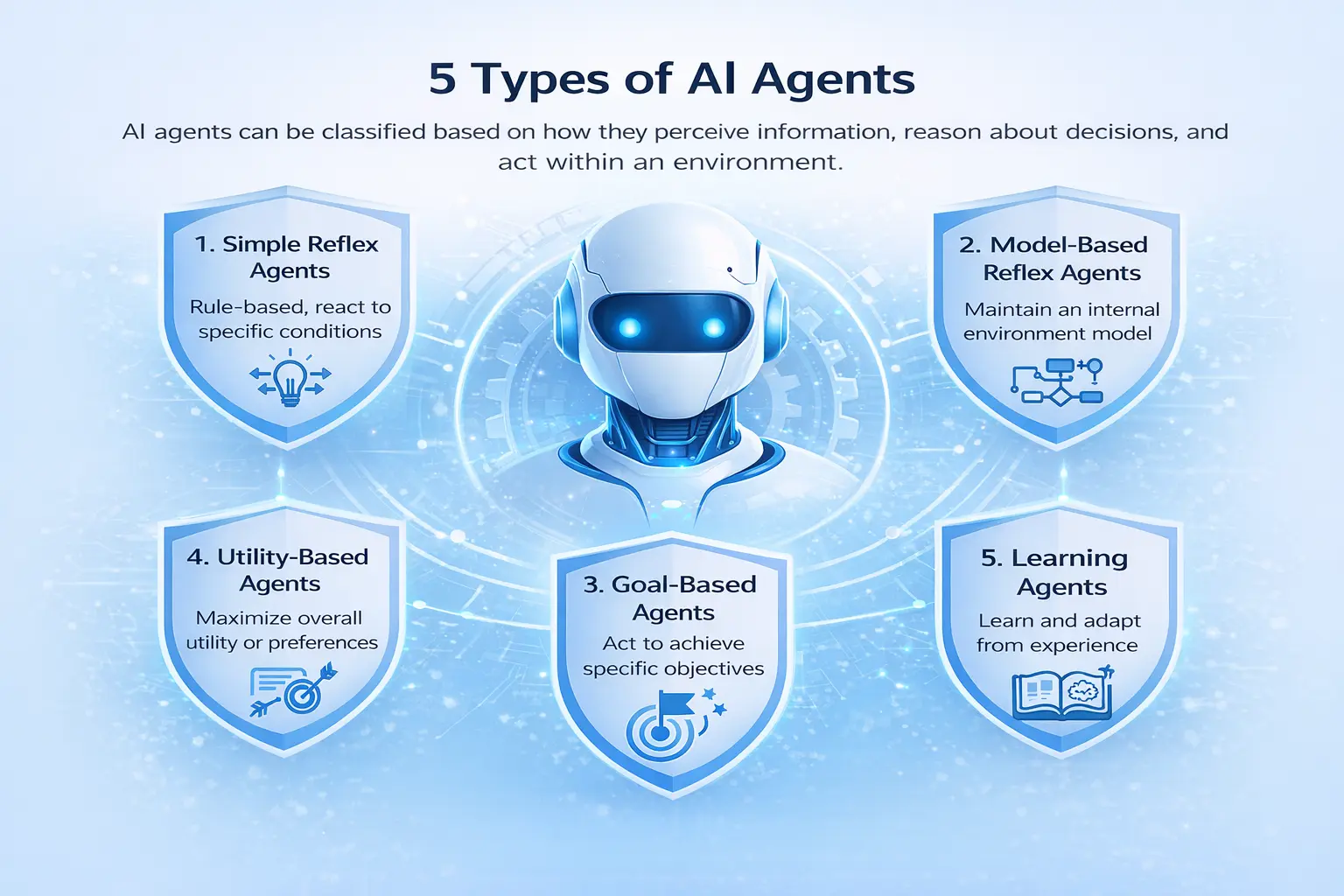
AI agents can be classified based on how they perceive information, reason about decisions, and act within an environment. Understanding these types helps businesses choose appropriate solutions and scope the right AI development services.
1. Simple Reflex Agents
Simple reflex agents operate on predefined condition-action rules. When a specific condition is met, the agent triggers a corresponding response.
These agents do not maintain memory of past states and do not reason beyond immediate inputs.
Business use cases often include basic alerts, rule-based classification, and simple automation tasks where conditions are predictable and stable.
From a development perspective, simple reflex agents are relatively fast to implement and cost-effective, making them suitable for early automation initiatives.
2. Model-Based Reflex Agents
Model-based reflex agents extend simple rules by maintaining an internal representation of the environment. This allows them to infer context that is not directly observable at any given moment.
They are commonly used in workflows where decisions depend on both current inputs and the state of an ongoing process.
For businesses, these agents enable more robust automation in environments with partial information or evolving conditions. Developing them typically requires structured modeling of system states, which is where experienced AI development services add value.
3. Goal-Based Agents
Goal-based agents evaluate potential actions based on how effectively they move the system toward a defined objective. Rather than reacting to inputs alone, they consider future outcomes when making decisions.
Examples include optimization systems, scheduling tools, and planning applications.
In business contexts, goal-based agents support scenarios where trade-offs exist and outcomes matter more than immediate responses. Their development requires clear goal definitions and evaluation logic, often shaped through close collaboration between business stakeholders and AI development teams.
4. Utility-Based Agents
Utility-based agents refine goal-based behavior by assigning numerical values—utilities—to outcomes. The agent selects actions that maximize overall utility, balancing multiple criteria such as cost, performance, and risk.
These agents are useful in complex decision environments, such as recommendation systems or resource optimization.
Because utility functions must accurately reflect business priorities, building these agents typically involves both technical modeling and strategic input, making professional AI development services particularly important.
5. Learning Agents
Learning agents improve their performance over time by learning from experience. They update their decision logic based on feedback, enabling continuous adaptation without manual rule changes.
These agents are commonly used in personalization systems, predictive analytics, and adaptive automation.
From a business standpoint, learning agents offer long-term value but require careful monitoring, retraining strategies, and performance evaluation—areas best handled through structured AI development services.
Read more: 5 Types of AI Agents Explained: A Practical Guide for AI Development Services
How Businesses Benefit from AI Agents
AI agents deliver value across multiple dimensions:
- Scalability: Automation scales decision-making without linear growth in staffing
- Consistency: Standardized logic reduces variability in outcomes
- Speed: Real-time response improves operational efficiency
- Adaptability: Learning mechanisms enable continuous improvement
These benefits explain why AI agents are increasingly embedded into core business systems rather than treated as experimental tools.
Where AI Agents Are Making the Biggest Impact
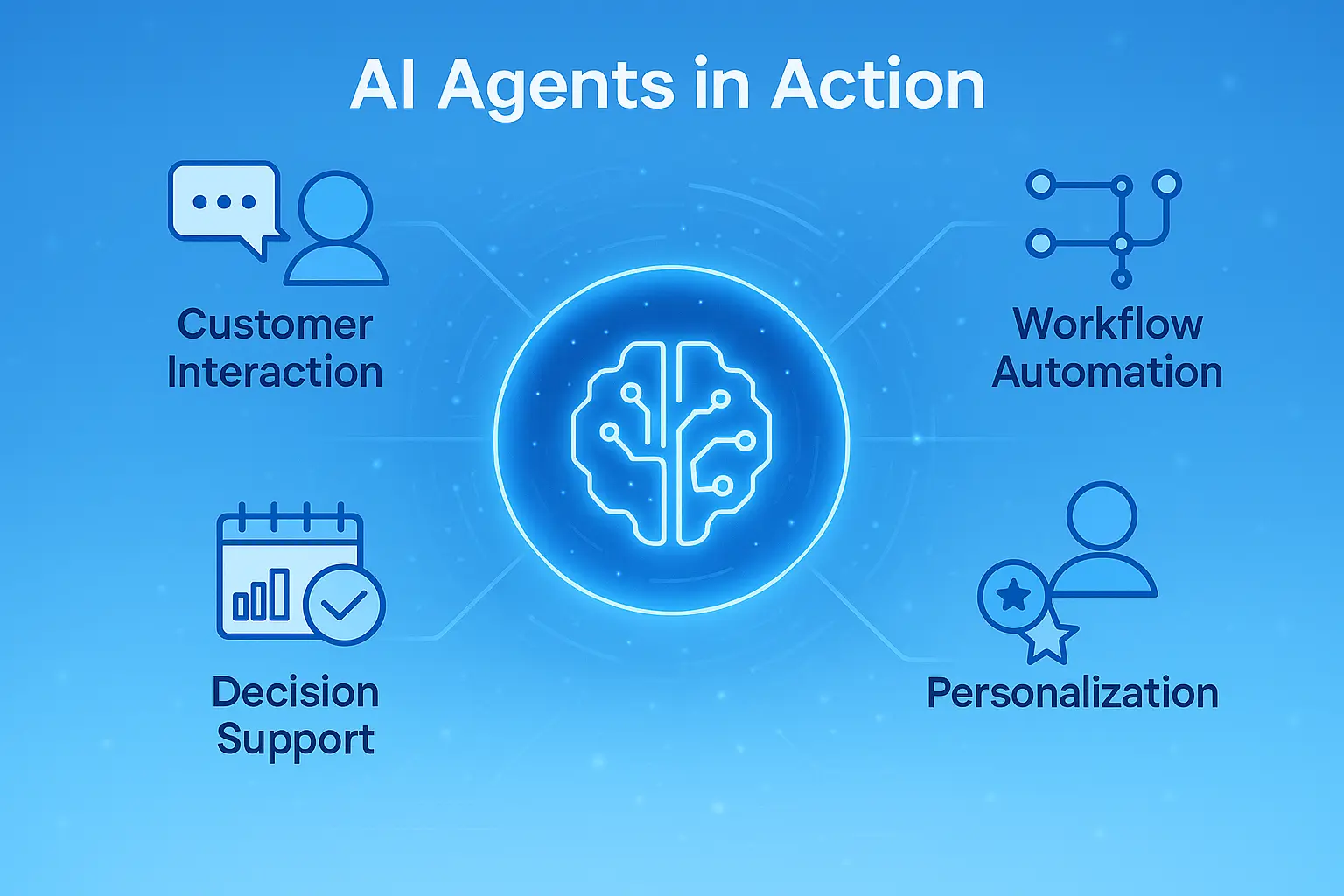
Although AI agents can be applied across many domains, their impact is most visible in areas involving repeated decisions, dynamic conditions, and the need for responsiveness.
One major area is customer interaction and support. AI agents handle routine inquiries, maintain conversational context, and route complex cases to human teams. This reduces response times and operational load while maintaining service quality.
Another important area is workflow and process automation. AI agents help manage multi-step workflows across systems, adapting to exceptions and changing conditions more effectively than traditional automation.
AI agents are also widely used in decision support and optimization. Goal-based and utility-based agents assist with prioritization, scheduling, and resource allocation, supporting faster and more consistent decisions.
Finally, personalization and adaptive services benefit significantly from learning agents that refine behavior based on user interactions, improving relevance and engagement over time.
In these areas, organizations typically achieve stronger results when AI agents are implemented with experienced AI development services that align technical design with operational needs.
When to Use AI Agents
AI agents are especially valuable when:
- Workloads grow faster than teams can scale
- Decisions require contextual reasoning
- Processes span multiple systems
- Personalization or real-time responses are required
- Business environments change frequently
In such situations, AI agents provide flexibility and intelligence that traditional systems struggle to deliver.
How to Approach AI Agent Development
Developing AI agents generally follows a structured lifecycle:
- Define clear business objectives
- Identify and prepare relevant data sources
- Select appropriate agent types
- Design decision logic or learning models
- Integrate agents with existing systems
- Test and validate behavior
- Deploy, monitor, and iterate
Professional AI development services support each phase, ensuring reliability, scalability, and alignment with enterprise standards.
Choosing AI Development Services
When selecting an AI development partner, businesses should evaluate:
- Technical expertise and relevant experience
- Understanding of the business domain
- Integration and architecture capabilities
- Testing and monitoring practices
- Long-term support and maintenance offerings
A strong partner focuses on delivering sustainable value, not just deploying models.
Conclusion
AI agents play a central role in modern intelligent systems, enabling automation, adaptability, and scalable decision-making. By understanding agent types, use cases, and development considerations, businesses can adopt AI more strategically and with greater confidence.
To turn AI agent concepts into production-ready solutions, organizations often rely on professional AI development services that bridge the gap between technical capability and business impact. With the right approach, AI agents become a powerful foundation for long-term digital transformation.
Relipa Software
Relipa Co., Ltd. is a Vietnam-based software development company established in April 2016. After two years of growth, our Japanese branch – Relipa Japan – was officially founded in July 2018.
We provide services in MVP development, web and mobile application development, and blockchain solutions. With a team of over 100 professional IT engineers and experienced project managers, Relipa has become a reliable partner for many enterprises and has successfully delivered more than 500 projects for startups and businesses worldwide.
